
How Does Minimally Invasive Arthroscopy Help Treat Joint Injuries?
Joint injuries can affect everyday activities such as walking, climbing stairs, bending, lifting objects, and participating in sports. Conditions involving cartilage, ligaments, tendons, and other joint structures may cause pain, swelling, stiffness, and restricted movement. Minimally invasive arthroscopy is a surgical technique that helps orthopaedic surgeons diagnose and treat several joint-related problems through small incisions.
What Is Minimally Invasive Arthroscopy?
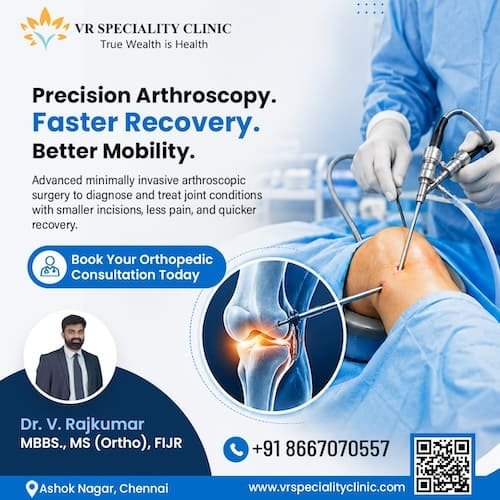
Arthroscopy is a surgical procedure that uses a small instrument called an arthroscope. It contains a camera and a light source that allow the surgeon to view the inside of a joint on a monitor.
Instead of making a large incision, the surgeon creates small openings to insert the arthroscope and specialised surgical instruments. This approach allows the surgeon to examine the affected area and perform the required treatment with minimal disruption to the surrounding tissues.
Arthroscopy is commonly performed on the knee, shoulder, ankle, wrist, and elbow joints.
How Does Arthroscopy Help Treat Joint Injuries?
Arthroscopy helps address different joint injuries by allowing surgeons to examine damaged structures and perform targeted procedures.
1. Treating Ligament Injuries
Ligament injuries, particularly anterior cruciate ligament (ACL) tears, can cause knee instability and difficulty with physical activities. Arthroscopic techniques allow surgeons to assess the injury and perform procedures such as ACL reconstruction when required.
2. Repairing Cartilage Damage
Cartilage damage can result in joint pain, swelling, and reduced movement. Arthroscopy helps identify damaged cartilage and allows suitable procedures to address the affected area based on the patient’s condition.
3. Managing Meniscus Tears
The meniscus is a cartilage structure in the knee that acts as a cushion between the thigh bone and shin bone. Tears may occur due to sports injuries, sudden twisting movements, or age-related changes. Arthroscopic surgery can help repair the tear or remove the damaged portion when appropriate.
4. Addressing Shoulder Injuries
Shoulder problems such as rotator cuff tears, labral injuries, and shoulder impingement can affect arm movement and strength. Arthroscopy allows surgeons to examine these structures and perform suitable repairs through small incisions.
Following the surgeon’s rehabilitation instructions is important for restoring joint movement and strength. For patients seeking Minimally Invasive Orthopedic Surgery Chennai, arthroscopy can be an option depending on the type and severity of the injury.
What Are the Benefits of Minimally Invasive Arthroscopy?
Arthroscopy offers several potential benefits compared with conventional open surgery, depending on the procedure and individual condition.
- Less disruption to surrounding tissues.
- Potentially less postoperative discomfort.
- May reduce certain wound-related complications.
- Potentially shorter hospital stays in selected cases.
- Better visualisation of joint structures during surgery.
- Rehabilitation based on individual recovery progress.
Recovery time varies depending on the joint involved, the extent of the injury, and the treatment performed.
Expert Guidance for Minimally Invasive Joint Surgery
Dr V Rajkumar provides orthopaedic consultation and surgical care for various joint conditions, including sports injuries, ligament tears, cartilage damage, and complex joint problems. His approach focuses on evaluating each patient’s condition and identifying suitable treatment options.
Treatment for joint injuries depends on the location and severity of the damage, the patient’s activity level and overall health. A Robotic Orthopedic Surgeon In Chennai can assess the affected joint, review diagnostic findings and discuss suitable treatment options, including arthroscopy when clinically indicated.
Early evaluation and appropriate treatment can help manage joint injuries, support rehabilitation, and improve mobility.